Overview
An end-to-end deep-learning pipeline for drone- and camera-based target identification. The system unifies heterogeneous public image datasets, trains a multi-output CNN that predicts both a fine-grained object class and a coarse valid/invalid label, and embeds the trained classifier behind a YOLO segmentation front-end for real-time video.
The work emphasizes practical concerns: dataset unification, label consistency, and computational efficiency, so the classifier can be dropped into a streaming application running on drone footage or fixed surveillance cameras.
Pipeline
Three modular stages, each independently upgradable.
-
Dataset builder: pulls images from multiple KaggleHub sources, reorganizes them into a
single
images/directory and a unifiedmetadata.csv, hash-dedupes, and aliases dataset-specific terms (e.g. birds / avian →bird) onto canonical labels. -
Multi-output CNN classifier: a regularized ConvNet with two heads: one over the 11
canonical fine classes, one over three coarse validity classes (
valid,invalid_nontarget,invalid_background). - Real-time utilization program: a YOLO segmentation front-end produces per-frame instance masks; each mask is cropped, normalized to match training, classified, and overlaid onto the source frame at the predicted coarse label's color.
Dataset
Source datasets use inconsistent directory layouts, label columns, and category names. The builder normalizes all of this into one corpus suitable for training.
Each fine label (e.g. soldier, civilian_vehicle, tank_av) is mapped
onto one of three coarse buckets. Labels are derived per source via folder names, CSV columns, or filename
regex, then aliased onto a canonical taxonomy. A per-class cap keeps dominant categories from swamping
training, and each image is assigned at random to a 70 / 15 / 15 train/val/test split. Unreadable files are
skipped, and hashing each re-encoded image catches the same picture appearing across multiple sources.
Model architecture
A compact multi-output ConvNet shared between two classification heads.
The backbone is three Conv → ReLU → MaxPool blocks with growing channel depth (32 → 64 → 128) and shrinking spatial resolution. The final feature map is flattened into a 256-unit dense layer with dropout, which feeds both heads:
- Fine head: an 11-way softmax over the canonical fine classes.
- Coarse head: a three-way softmax over the validity categories, read from the same shared features.
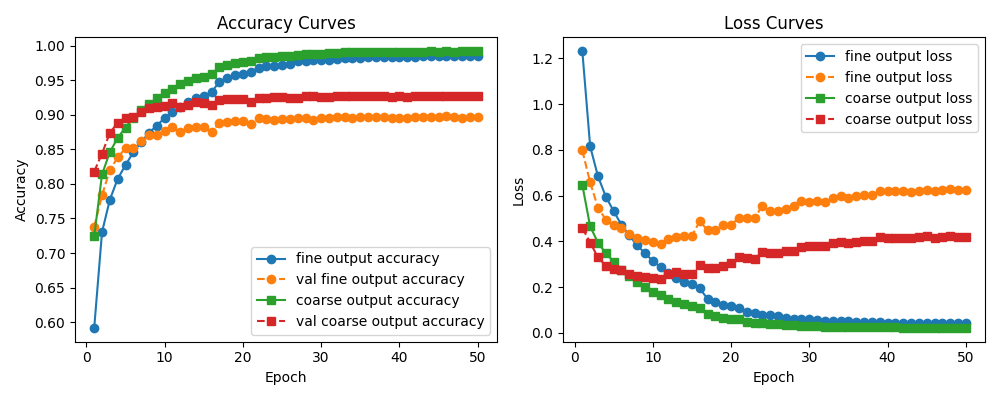
Both heads train jointly with sparse categorical cross-entropy, weighted equally. L2 regularization on every kernel and 50% dropout mitigate overfitting; AdamW with a plateau-triggered LR schedule rounds out the optimizer setup, and the checkpoint with the lowest validation loss is kept.
Training
Implemented in TensorFlow with tf.data pipelines built directly from metadata.csv.
Each row loads its image via out_relpath, decodes to RGB, resizes to a fixed input resolution,
and scales pixel values to [0, 1]. No augmentation is applied.
Every sample carries equal weight. An optional flag controls whether invalid examples contribute to the fine-head loss: when it is set, invalids train only the coarse head, freeing the fine head to focus on examples with meaningful fine labels. Both heads train together from the first epoch.
Results
Held-out test set: 27,362 samples across 11 fine classes. Naïve single-class baselines reach 23.5% (fine) and 34.5% (coarse), so both heads must learn real structure to be useful.
- 87.1% Fine accuracy 11-class softmax vs. 23.5% baseline
- 91.3% Coarse accuracy 3-way valid/invalid vs. 34.5% baseline
- 0.836 Fine macro F1 Precision 0.857 / Recall 0.821
- 0.913 Coarse weighted F1 Precision 0.913 / Recall 0.913
Fine confusion matrix
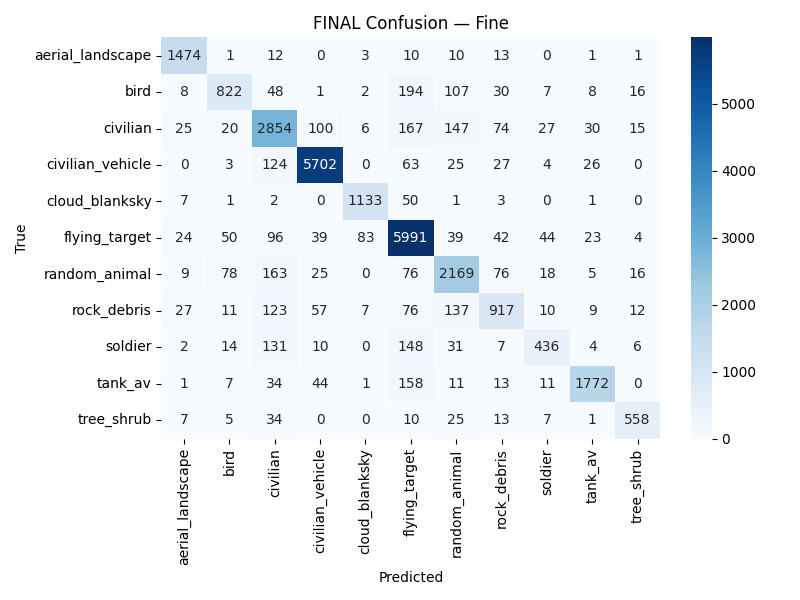
Test set confusion matrix for the 11-class fine head. Strong diagonal dominance, with errors spread across many pairs rather than clustered: the largest, civilian / random_animal, is 310 of 3,534 misclassifications, and flying_target is the most common wrong prediction (952).
Per-class precision
The fine head is strongest on visually distinct categories (vehicles, landscape) and weakest where classes share appearance (rock debris, soldier, civilian). Recall is lowest on soldiers: 436 of 789 are found, with 148 of the misses going to flying_target and 131 to civilian.
| Class | Precision |
|---|---|
| civilian_vehicle | 0.9538 |
| tank_av | 0.9426 |
| aerial_landscape | 0.9306 |
| cloud_blanksky | 0.9174 |
| tree_shrub | 0.8885 |
| flying_target | 0.8629 |
| bird | 0.8123 |
| random_animal | 0.8027 |
| civilian | 0.7882 |
| soldier | 0.7730 |
| rock_debris | 0.7547 |
| Class | Precision |
|---|---|
| invalid_nontarget | 0.9277 |
| valid | 0.9165 |
| invalid_background | 0.8941 |
Error analysis
Confusion matrices and qualitative review highlight three recurring failure modes.
- Borderline crops: segmentation masks that mix target and background pixels. When background dominates the crop, the classifier defaults to an invalid label even when part of a target is visible.
- Small or occluded targets: distant or partially blocked objects provide too few pixels for confident fine-class prediction.
- Visually similar classes: soldier vs. civilian and bird vs. random_animal are visible confusions, but no single pair dominates. In the coarse head, invalid_background vs. valid (883 of 2,377 errors) edges out invalid_nontarget vs. invalid_background (844).
Input resolution trade-off
Bumping inputs from 64×64 to 128×128 significantly improved both fine and coarse accuracy; 256×256 added very little. For offline classification, 128×128 is the sweet spot. For the live video pipeline, lower-resolution crops actually helped: they kept the YOLO + CNN loop closer to real time and improved detection of small, distant targets thanks to the larger effective receptive field.
Real-time utilization
The deployment program runs against video files (with webcam and live drone feed as future targets). YOLO produces per-frame instance masks; each mask is cropped from the source frame, resized to the CNN's input size, and normalized identically to training. Only the coarse head is consulted in the live overlay: the operational question is "valid target?", and the three-way decision is fast and easy to render:
- valid: green overlay, labelled with a track ID and the coarse-head confidence.
- invalid_nontarget: red overlay, signalling a real object that is not the target.
- invalid_background: suppressed entirely.
Optional frame skipping keeps throughput up. Decoupling detection from classification means a newer YOLO model can drop in without touching the CNN, and adding new fine classes only requires retraining the classifier.
Limitations & future work
- Data coverage: performance is bounded by the diversity of the unified training set. Drone altitude, camera angle, lighting, and environmental context all affect generalization.
- Small targets: objects that occupy only a handful of pixels remain the hardest case.
- No temporal smoothing: the live overlay treats each frame independently, so detections on borderline crops can flicker between coarse labels across consecutive frames.
- Next directions: temporal modelling across consecutive frames, backbones pretrained on aerial imagery, active-learning loops fed by uncertain detections, and lightweight backbones (MobileNet-class) for constrained hardware.
Links
The source code, the training dataset, and the full technical writeup.